
Ars ex Machina / Bee
Built
for the field.
A field rover for selective strawberry harvesting.
Explore in motion6×6 chassis · RGB-D vision · eight manipulators
01 The field challenge
Ripe berries
cannot wait.
Harvesting is one of the most labour-intensive parts of berry farming. Seasonal workers are scarce, and ripe fruit must be picked on time. Bee is being developed for this daily work.
Ripeness and position
The detector finds the berry, the classifier estimates ripeness, and segmentation outlines the fruit. Depth within the mask gives the distance to the target.
By the stem
The camera tracks the target. The manipulator guides the tool to the stem: grip, draw towards the blade, cut and place in a container.
The next pass
Tracking unripe berries is intended to help forecast yields and allocate equipment.
02 Move
A field is
no parquet floor.
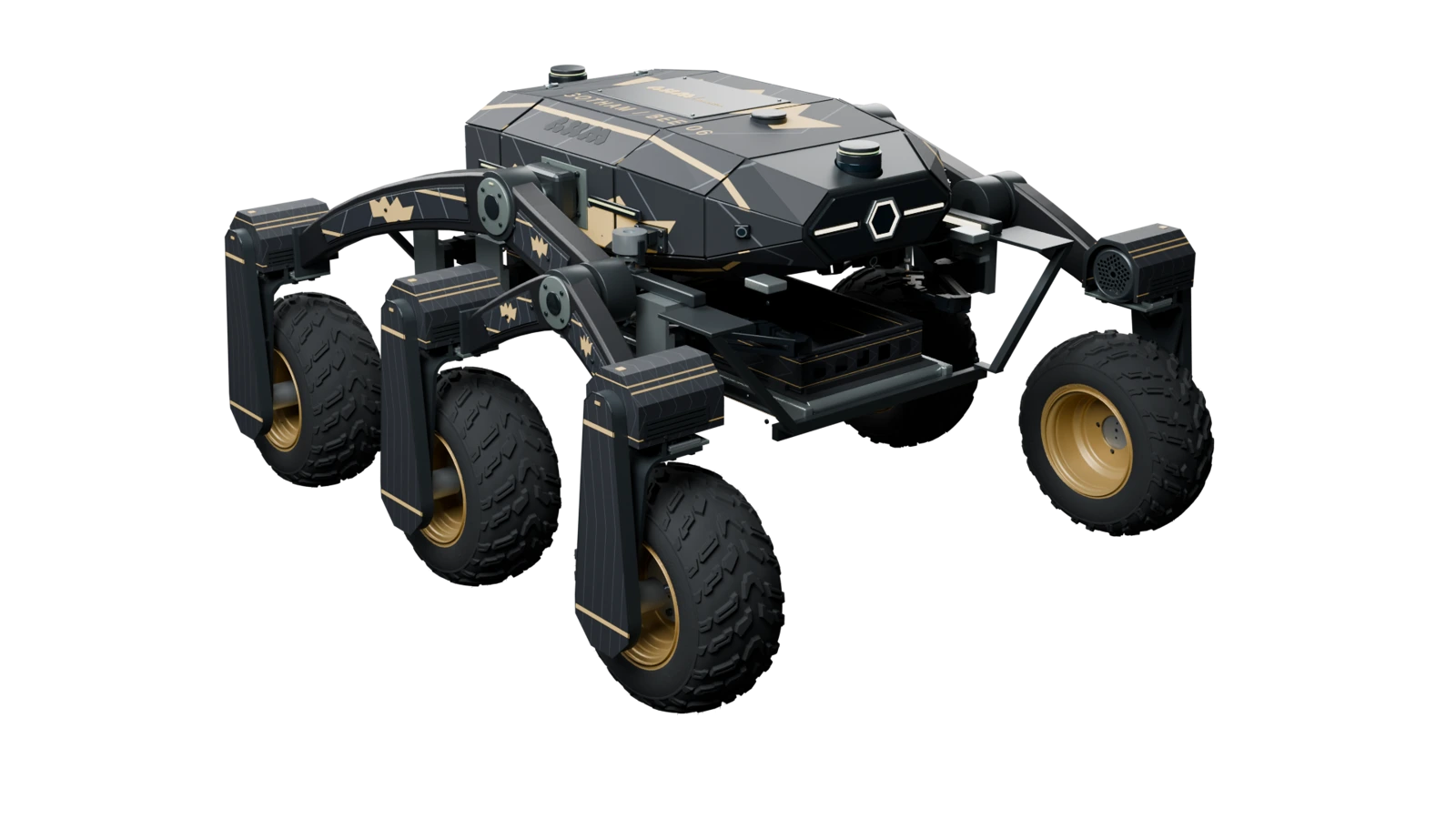
Rocker-bogie is a suspension design developed at NASA/JPL for Mars rovers. Rocker arms and two-wheel bogies distribute loads across six wheels. A differential link between the two sides reduces body tilt on uneven ground.
- Chassis layout
- 6×6
- Suspension
- Rocker
bogie
Bee’s wheels travel between rows, with the crop bed beneath the body. In the C1 layout, the rocker linkage sits below the central battery.
Design history · NASA/JPL03 See all around
The field around.
The path ahead.
Six cameras provide an all-around view of the rows, people and obstacles. Two lidars, front and rear, measure distances. RTK refines the rover’s position using corrections from the farm base.
360° view → obstacle → distance → position
The RTK design target is 1 cm with base corrections. The scene illustrates sensor operation; navigation accuracy still needs field validation.
- Surround cameras
- 6 / 360°
- Lidars
- 2
- RTK · target with corrections
- up to 1 cm
04 Power and protection
Energy
for the shift.
A swappable pack contains 16 VariCore LiFePO₄ cells of 360 Ah, connected in series. Lithium iron phosphate chemistry was chosen for thermal stability and long cycle life. The BMS monitors cell voltage, current and temperature, while a balancer equalises charge. Protection limits overcharge, deep discharge and overload.
- LiFePO₄ cells
- 16
- Cell capacity
- 360 Ah
- Pack energy
- 18.4 kWh
Nominally 51.2 V × 360 Ah. The cell manufacturer claims 8,000+ cycles; the product listing does not disclose the test conditions. Bee’s target runtime is around 10 hours, to be verified in the field.
Cell specifications · VariCore05 From vision to harvest
Find the berry.
Pick it gently.
Each gripper has a RealSense D405: colour and depth at 7–50 cm. Detection, ripeness assessment and segmentation isolate the berry. The onboard Jetson AGX Orin 64 GB processes the data and guides the arm.
- Find
- Approach
- Grip
- Draw to blade
- Cut
- Place
The camera tracks the target. In V13.3, a cable closes the jaws and draws the stem to the blade. The berry stays in the gripper. Placement and a coordinated arm cycle are the next testing stage.
- RealSense D405
- 8
- Jetson AGX Orin
- 64 GB
- Arms per side
- 4 + 4
06 Run the numbers for your own field
What that means
in berries.
Throughput is calculated from one arm’s cycle: 3,600 seconds ÷ cycle time × 8 arms × number of rovers. Berry mass converts the result into kilograms.
07 Seasonal modules
One Bee.
Different seasons.
The chassis, power system and onboard computer are shared. The task determines the working tool, recognition model and motion program. The applications below are part of the development plan.
Berry picking
RGB-D vision, eight arms, placement in containers and size estimation. A runner detector is being trained separately.
Weeding
Recognising weeds and working alongside the crop.
Spraying
Targeted treatment of individual plants.
Mowing
Maintaining the aisles while monitoring the surroundings.
Snow clearing
A winter module and battery heating.
Planting
Placing plants on an RTK grid matched to the field layout.
08 Bee / Queen / Hive / Apiary
A field working
as a system.
In the target architecture, the dashboard assigns rows and tasks, the onboard computer executes local actions, and telemetry reports machine status. Separate units handle harvest logistics and energy.
Collect and cool
A separate machine on its own chassis. It exchanges full crates for empty ones and sorts fruit by size and quality; the target cargo temperature is +2 °C. At the specification stage.
Back to work
A planned station for charging and swapping the complete battery pack. Grid or solar power; docking mechanics and continuous support for the pack are still being designed.
See the whole field
Field maps, tasks, work zones and telemetry. The dashboard is already available; robot movement in the demo is simulated.
Open the dashboard demo09 Field, service and safety
From a model
to a farm.
We are starting with our own berry farm near Moscow. It provides real crop beds and tasks. Vision is already being tested; full robotic harvesting in the field is the next stage.
How will the machine navigate the rows?
The design uses cameras to identify crop beds and aisles, RTK to refine map position, and lidar to detect obstacles. This is a separate system from the eight D405 cameras at the grippers. Track width and ground clearance are matched to the planting layout; a dedicated RTK base is planned in Beekeeper.
Check a fieldHow is maintenance planned?
Spare parts, scheduled servicing, firmware and vision-model updates. A replacement machine and telemetry-based failure prediction are part of the pilot plan.
How will the machine work around people?
The design includes a protective zone monitored by cameras and lidar, a physical emergency stop, visual and audible signals, and operator supervision. Stop performance and prototype safety must be tested before field operation.
11 Our own farm. Measurable results.
Not just words —
proven in the field.
Our own berry farm in the Moscow region provides real crop beds, lighting and tasks. The perception pipeline is already assembled: berry detection and ripeness estimation, depth, stem localisation and arm approach calculation.
The strawberry detector has been updated to v4. Ripeness classification and segmentation are unchanged; leaf and runner recognition are being trained separately. The full-size machine is still in development, with field trials of the complete harvesting cycle ahead.
Strawberry detector / v4
- Precision
- 93.1%
- Recall
- 84.0%
- mAP50
- 93.1%
- mAP50–95
- 60.2%
From the developer’s report dated 8 October 2026. Detector metrics do not measure complete harvesting success; the evaluation dataset and conditions are being clarified.
From model to the real world
Project in developmentNext stop:
a real field.
We have our own berry farm and a specific task. Bee is now moving from an engineering model to a prototype. Field trials are still ahead.
Talk to us